
It is hard to say when and how I first became involved with Bhutan. That interest certainly dates back to my childhood. The Thunder Dragon was likely hiding in a comic book. The snow-capped peaks of a distant land appeared unobtrusively on the pages of a children’s atlas. How was life in that small space tucked between vast Tibet to the north and populous India to the south? Occasional references to remote Himalayan regions in reprints of old Junior Woodchuck manuals sparked new stories and coordinates for a European child. In the early 1990s, in a small town in the Latin Valley, finding a book dedicated to Bhutan seemed like a feat worthy of a research grant. The Internet was a rarity. I remember the thrill of obtaining a printout of the Tibetan alphabet for the first time from a small, forgotten website. Then came a travel guide and the excitement of seeing those first “.bt” web addresses.
At twelve, I had a vivid encounter with a small, sad yak at a circus. Perhaps my schoolmates were looking for lions. I lingered before that new friend—eyes hidden beneath thick fur—and indulged in thoughts about a distant land. How did my new friend feel to be there?
Then came classical studies during my teenage years, followed by political studies at university. I remember a conversation with a friend who wanted to work for the United Nations. She succeeded. I, on the other hand—as I told her—wanted to go to Bhutan. I succeeded too. Shortly after graduating, I contacted the Sherubtse College, and an opportunity finally opened up just after I began my PhD. And so, I made it to the country.

I recall my first evening in Thimphu, exploring the side streets off Norzin Lam in search of a watch and an internet café. The place was as I had imagined it before the long journey east with Namkha—the best friend I had only just met. We were both heading to that village. Kanglung. What I remember first about Kanglung is the rain. Twenty days of rain and fog, but also the new friends and the support they offered during those initial challenges. Namkha, of course, followed by Madhu, Sarbajeet, the director, other colleagues, my students. The village itself. The extraordinary opportunity to become part of it. Not just a European boy in the village, but the European boy of the village—right from the start.
Kanglung was tough and isolated, yet incredibly beautiful. I truly realised this when, after twenty days, I finally saw it bathed in warm sunlight. The mild autumn of Eastern Bhutan accompanied my classes, where I learned far more from students than I taught. The Bhutan I had only read about in rare books was right there, embodied in the people. My memories of that year are magnificent—moments like meeting Their Majesties or gazing in awe at the dzongs. Yet I also remember a gentle daily life, as sweet as the drowsy evenings in Trashigang or the unhurried afternoons spent in the library.
Bhutan has stayed with me ever since. It became the setting for much of my research and is now the focal point of my work as an Associate Professor of Asian History and Institutions at the University of Florence. But it has also stayed with me through the friends I made during those months—friends I have since reconnected with —their lives and mine continuing along a shared path that began in those remote mountains.
Matteo Miele
Associate Professor
University of Florence, Italy

From Pandemic Lockdowns to Niigata’s Deep Snow
I would tell myself to be far more patient during those first overwhelming months, and to worry less about adjusting perfectly… start learning conversational Japanese…to connect a little deeper
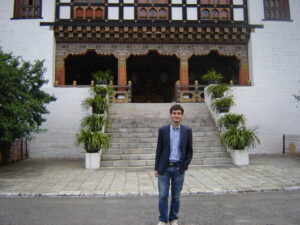
The European boy of the village
Bhutan has stayed with me ever since… It has also stayed with me through the friends I made during those months—friends I have since reconnected with —their lives and mine continuing along a shared path that began in those remote mountains.

Somewhere Between Melbourne and Home
When I arrived in Melbourne in 2023, my biggest fear wasn’t my Master’s programme—it was the tram system. That taught me something valuable: everything that intimidates you becomes part of who you are.
Walking into my first classroom, I realized I knew far less than I thought. My classmates from different countries taught me to listen, question my assumptions, and see beyond my own perspective.

Putting the National Day into Context
I will tell a story, a story of Bhutan that I am very much part of. Perhaps you and I can contextualise it more to Bhutan’s journey than my regurgitating of the standard and established approach of retelling the narrative would otherwise do. In the late 1980s, my mother was contributing Zhabto Lemi (voluntary labour contribution) in Mongar to construct a school in her village where she would later send her eldest child. Around the same time, Honourable Deborah Keith was working in Paro to transform and improve Bhutan’s agriculture sector. My mother must not have met my father yet at that point in time.

The Weight and Wonder of Cambridge
Getting a scholarship to study at Cambridge in 2023 came with a very neat idea of what the experience would be. It was not merely a reward, but also came with a quiet pressure to excel, make the most of it and especially, to prove that the scholarship committee had not made a mistake. It was also my first time studying outside Bhutan, which made the experience feel even larger than the scholarship itself. It was beyond something I could’ve ever afforded on my own.

Extra-curricular exploration and inspiration
What are we here for? It’s a question we all come back to from time to time – when there’s a gap in the pressures of ‘everyday’.
It’s a big one – especially if you think that you are only on this earth but once. It’s relevant – in a slightly different way – even if you may be back again (and again). But we can save the very serious philosophical discussions to another day.